
Author Instructions
Instructions for Authors (02/19/26)
Formating A New Chapter
- Use doc or Word.docx
- Use Arial font throughout
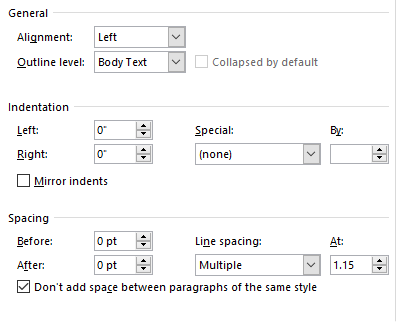
- Paragraph settings (see below)
Title Page
- CHAPTER TITLE-BOLD, ALL CAPS, 14PT (Heading 1)
- Authors and degrees (BOLD, 12 point) All new authors must register as ENDOTEXT users in order to be listed as authors (registration is free).
- Affiliations (Please give appropriate titles and affiliations, and e-mail addresses for all authors) 10 point
Example
DIABETIC RETINOPATHY
Jay M. Stewart, M.D., Professor, Department of Ophthalmology, University of California San Francisco, San Francisco, CA 94143. ja*********@**sf.edu
Marco Coassin, M.D., Ph.D., Associate Professor, Department of Ophthalmology, University Campus Bio-Medico, Rome, Italy. m.*******@*******us.it
Daniel M. Schwartz, M.D., Professor, Department of Ophthalmology, University of California San Francisco, San Francisco, CA. Da**********@**sf.edu
Abstract
- An Abstract suitable for indexing on PubMed should be included. 11 point
- Word limit 500
Headings
- CHAPTER MAIN SECTION HEADINGS (H2) (BOLD, ALL CAPS, 11 POINT, BLUE) (Heading 2)
- Sub-section Headings (H3) (Bold, Capitalize Each Word, 11point, Green) (Heading 3)
- Sub-Sub Section HEADINGS (H4) (CAPITALIZE WORDS,11pt, Red) (Heading 4)
- Sub-sub-sub section headings (H5) Italicize, 11point, Orange (Heading 5)
- Using the above colors will ensure that we correctly indicate your headings during formatting
Example
EPIDEMIOLOGY
Cholesterol and Triglycerides
LOW DENSITY LIPOPROTEIN CHOLESTEROL
Apolipoprotein B
Text
- Separate paragraphs by a space. Do not indent.
- Insert reference numbers into the text in parentheses (1, 2) and list references at the end of the chapter numerically in order of appearance. Use any number of references you wish. The style for references is that used in JCEM.
- We encourage you to cite other Endotext chapters whenever appropriate. Endotext chapters are indexed on PubMed so they are easy to reference using reference managing systems such as EndNote, and this will increase the visibility of our website.
- If appropriate you can state “additional information can be found in the chapter entitled “_____” in the ____ section of Endotext (reference #). Do not use chapter numbers as this can change as we add and subtract chapters
- Most importantly, please use sections to divide chapters as it makes it easier for readers to rapidly find information
- Line Spacing- this should be 1.15. There should be a space between all new paragraphs
Tables and Figures
- We would recommend very liberal use of Tables and Figures since these can provide quick and effective information for practicing physicians who may not have time to read a large text.
- Please insert tables and figures directly in the text where you want them to appear. We recommend having an average of one table or figure for each 2-3,000 words.
- Create Tables using the MS Word table function. Please list the Table title in the Table in bold type. (see example below)
- Use of colored figures is strongly encouraged! Please insert figures directly in the text, and use “JPEG”, GIF, or PNG format. Please do not include the figure title, number, or legend within the figure. Figure legends should be below the figure and in bold
- As usual, we will need written permission to re-use any figure published elsewhere. Since many journals charge for permission to re-use a figure, and we are unable to provide support for this expense, it is often preferable to modify an illustration so that it is not the same as the original, or to produce a new figure.
Table Formatting
Table reference:
Format Table Reference as: (Table 1)
Example:
Order a correctional scale that compliments the nutritional insulin based on total insulin dose or BMI for individuals who are tolerating an oral diet or bolus tube feeds. Order an every-4-hours correctional scale based on (Table 1).
Table header:
Format Table Header as: Table 1. Table Title
Example:
Table 1. Etiology of Cushing’s Syndrome |
ACTH-dependent |
Pituitary-dependent Cushing’s syndrome (Cushing’s disease) |
Figure Formatting
Figure reference:
Format in text Figure reference as: (Figure 1)
Example:
WHO- sponsored effort to address the public health implications of T1D. The incidence of T1D between 1990 and 1994 in 50 countries is shown in (Figure 1).
Figure caption:
Format Figure captions as: Figure 1. Caption text…
Example:
Figure 1. Worldwide incidence of T1D 1990-1994, used with permission from International Diabetes Federation.
CITATIONS:
NOTE: If using EndNotes, do not manually format as formatting will be done automatically.
Format Citations: (1) (1,2,3)
Example:
Because of the psychological and social stigmata that accompany developing overweight and obesity, those affected by these conditions are also vulnerable to discrimination in their personal and work lives, low self-esteem, and depression (1).
Format Reference:
Format as the ordered numbered list as we currently do (no manual numbering).
Example:
1. Rubino F, Puhl RM, Cummings DE, Eckel RH, Ryan DH, Mechanick JI, Nadglowski J, Ramos Salas X, Schauer PR, Twenefour D, Apovian CM, Aronne LJ, Batterham RL, Berthoud HR, Boza C, Busetto L, Dicker D, De Groot M, Eisenberg D, Flint SW, Huang TT, Kaplan LM, Kirwan JP, Korner J, Kyle TK, Laferrere B, le Roux CW, McIver L, Mingrone G, Nece P, Reid TJ, Rogers AM, Rosenbaum M, Seeley RJ, Torres AJ, Dixon JB. Joint international consensus statement for ending stigma of obesity. Nature medicine. 2020;26(4):485-497.
Others
- In an effort to convey the chronic nature of many of the diseases referred to in this textbook, where applicable, please refer to patients “with acromegaly,” “with diabetes,” “with hypertension,” or “who are obese,” rather than “acromegalics”, “diabetics,” “hypertensives,” or “obese patients.”
- DOSAGES AND SPECIFIC TREATMENTS – Please check all references to dosages and specific treatments very carefully.
- COPYRIGHT The copyright is owned by MDText.com, INC. For newly written chapters, the authors will transfer copyright to the chapters to MDText.com, INC.
- Please be sure to add your Endotext publication to your own CV, and to cite it in your lectures and publications. As noted, chapters are indexed on PubMed and therefore are very easy to cite.